
Stem Cell Therapy for Avascular Necrosis in India
For patients with early-stage avascular necrosis of the hip, knee, or shoulder, HealPassage connects you with orthopedic specialists in India experienced in core decompression with stem cell augmentation — a joint-preserving option worth exploring before joint replacement becomes the only path forward.
What Is Avascular Necrosis?
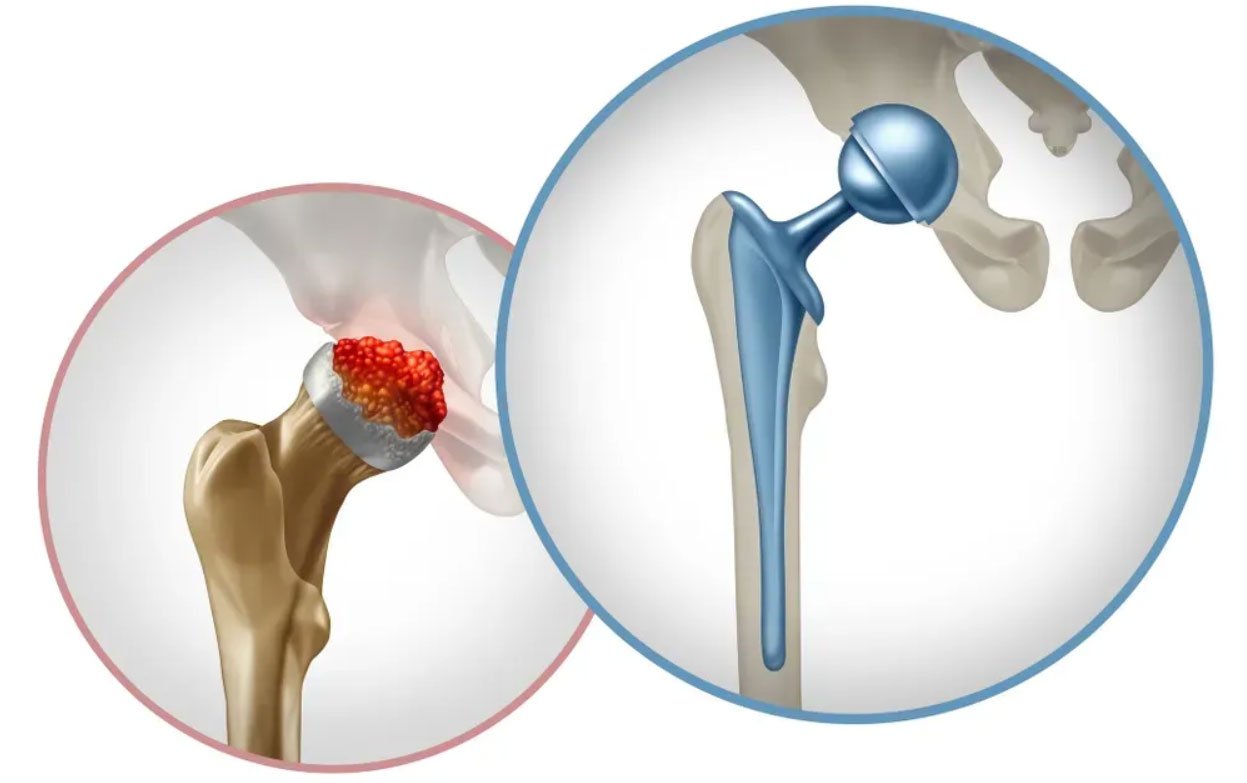
Avascular necrosis (AVN), also called osteonecrosis, is a condition where bone tissue dies due to a disrupted blood supply. Understanding the stage of your condition is critical to knowing which treatment options are realistic.
Bone tissue, like all living tissue, needs a continuous blood supply to stay healthy. When that blood flow is interrupted — due to injury, certain medications, or other underlying conditions — the affected bone cells begin to die. Over time, this can cause the bone structure to weaken and eventually collapse, most commonly affecting the femoral head (top of the thigh bone) at the hip joint.
AVN most frequently affects the hip, though it can also occur in the knee, shoulder, or ankle. It often develops gradually, which is part of why early diagnosis matters so much — the disease is progressive, and treatment options narrow significantly as it advances.
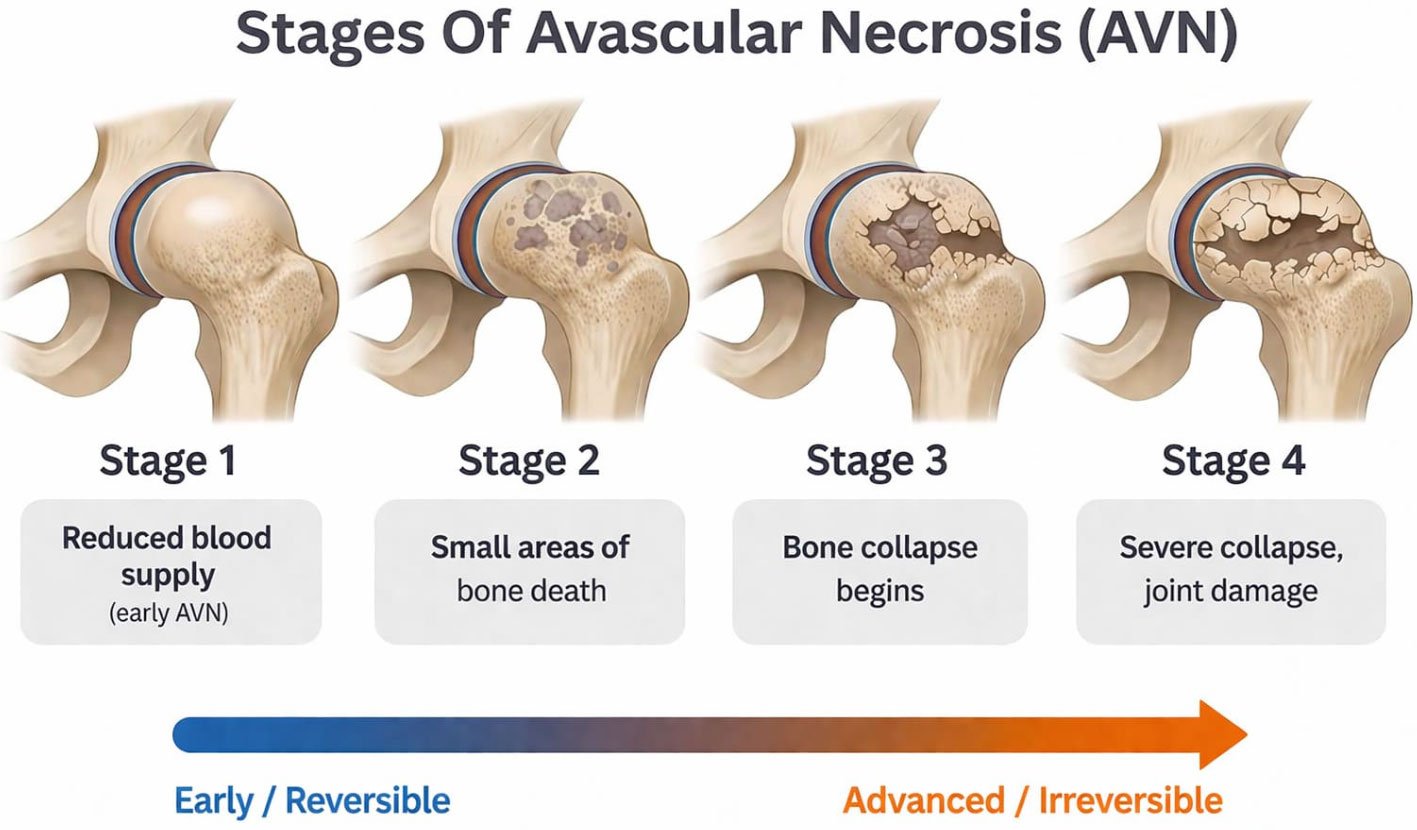
This is the single most important thing to understand about AVN: it is staged, and the stage you're diagnosed at is the biggest factor in determining whether joint-preserving treatment is realistic, or whether joint replacement is the more appropriate path.
Common Causes & Risk Factors
Long-Term Steroid Use
High-dose or prolonged corticosteroid use is one of the most common non-traumatic causes.
Trauma or Fracture
Hip fractures or dislocations can directly damage blood vessels supplying the bone.
Excessive Alcohol Use
Chronic heavy alcohol consumption is linked to fat buildup in blood vessels feeding the bone.
Underlying Conditions
Sickle cell disease, lupus, and certain clotting disorders increase risk.
Stages of Avascular Necrosis
Early Stage
Bone changes visible only on MRI; X-rays often appear normal. Bone shape is still intact.
Best window for treatmentPre-Collapse
Changes now visible on X-ray, but the bone hasn't yet collapsed or lost its round shape.
Good candidacy for joint-preserving optionsEarly Collapse
The bone surface begins to flatten or crack ("crescent sign"), causing structural weakening.
Case-by-case evaluationAdvanced Collapse
Significant bone collapse with joint surface damage, often affecting the adjacent joint cartilage.
Usually needs joint replacementHow Stem Cell Therapy Works for Avascular Necrosis

The most established joint-preserving approach for early-stage AVN combines a surgical technique called core decompression with autologous stem cell augmentation. Here's what the process typically involves.
Stem Cell Collection
Cells are harvested from your own bone marrow, typically from the pelvic bone (iliac crest), under local or light general anesthesia. The sample is then processed to concentrate the mesenchymal stem cells for use in the affected joint.
Core Decompression
The orthopedic surgeon drills one or more small channels into the affected area of bone (commonly the femoral head at the hip). This relieves internal pressure, removes dead bone tissue, and creates space and a fresh blood supply pathway for healing.
Stem Cell Injection into the Decompressed Area
The concentrated stem cells are introduced directly into the drilled channel(s), aiming to support new bone formation and improve blood supply to the affected area. This is done in the same surgical session as the decompression.
Protected Weight-Bearing & Rehabilitation
You'll typically need crutches or a walker for several weeks to protect the treated bone while it heals, followed by a structured physiotherapy program to gradually restore strength and mobility.
What to Expect After Treatment
Limited or protected weight-bearing on the treated joint using crutches, as advised by your surgeon.
Gradual increase in weight-bearing, alongside physiotherapy to rebuild strength and range of motion.
Follow-up imaging (MRI or X-ray) to assess bone healing and whether the joint structure has been preserved.
Longer-term assessment of joint health, with continued monitoring recommended even if results are positive.
Is Joint-Preserving Treatment Right for You?
More than almost any other condition on our site, candidacy for AVN treatment comes down to one factor above all: how far the condition has progressed at diagnosis.
You May Be a Good Candidate If:
- ✓Your AVN is diagnosed at Stage 1 or 2 — before the bone has collapsed or lost its round shape.
- ✓Imaging (MRI/X-ray) shows the joint surface is still largely intact.
- ✓You're able to manage a period of protected weight-bearing (crutches) during recovery.
- ✓You're in reasonably good general health, without uncontrolled underlying conditions driving the AVN (e.g., unmanaged lupus).
- ✓You understand this aims to preserve the joint and delay/avoid replacement — not guarantee a permanent fix.
May Need a Different Approach If:
- !Your AVN is Stage 3 or 4 — the bone has already collapsed or the joint surface is significantly damaged. Joint replacement is usually the more reliable option at this stage.
- !You have an active infection or uncontrolled autoimmune flare at the time of evaluation.
- !The underlying cause of your AVN (such as ongoing steroid use) hasn't been addressed — treating this may be needed alongside any procedure.
- !You're unable to comply with the weight-bearing restrictions needed for the bone to heal properly.
- !You're expecting a guaranteed outcome — results vary, and even in early-stage cases, some patients eventually still require joint replacement.
Not sure what stage your AVN is at?
Send us your MRI or X-ray report. Our partner orthopedic specialists will review your imaging and give you an honest opinion on whether joint-preserving treatment is realistic for your case, or whether replacement is the more sensible path.
Get a Free Specialist Opinion →Cost of Stem Cell Therapy for Avascular Necrosis in India
Since this involves a surgical procedure (core decompression) combined with stem cell augmentation, costs are higher than a simple injection-based treatment — but still significantly lower than equivalent care abroad.
How India Compares Globally (Approximate, Per Hip)
Core Decompression + MSC
Covers cell harvesting, the decompression procedure, and stem cell injection into one hip.
Both Hips Affected
Many patients with AVN in both hips can be treated in the same surgical session.
Knee or Shoulder AVN
Similar core decompression approach applied to other affected joints, priced comparably.
What's Typically Included
- Pre-procedure consultation & imaging review
- Bone marrow stem cell harvesting
- Core decompression surgery
- Stem cell processing & injection
- Hospital stay (typically 2–3 days)
- Initial post-op follow-up consultation
These figures are general estimates and vary based on your surgeon, hospital, and the extent of joint involvement. They typically do not include travel, extended accommodation, physiotherapy after discharge, or follow-up imaging at 3/6/12 months — your coordinator will provide a full itemized quote after reviewing your imaging.
Frequently Asked Questions
Answers to what patients most often ask about stem cell therapy for avascular necrosis.
The cost typically ranges between $5,000 and $6,000 USD per joint. The overall expense depends on the procedure technique (such as combining stem cell infusion with Core Decompression), hospital stay, and the stage of AVN.
The success rate is 70% to 85% when treated in the early stages (Stage 1 and Stage 2) before joint collapse occurs. It effectively regenerates bone tissue, reduces hip pain, and significantly delays or avoids the need for Total Hip Replacement (THR). It is not recommended for advanced stages (Stage 3 or 4).
It's possible, but only in early-stage AVN (Stage 1–2), where the bone hasn't yet collapsed. Core decompression with stem cell augmentation aims to relieve pressure and support new bone formation before permanent structural damage occurs. Once the bone has collapsed (Stage 3–4), joint-preserving treatment is much less likely to succeed, and hip replacement typically becomes the more reliable option. Your imaging will determine which category you fall into.
Core decompression is considered a minimally invasive orthopedic procedure compared to joint replacement — it doesn't involve removing or replacing any part of the joint. That said, it is still a surgical procedure performed under anesthesia, typically requiring a short hospital stay of 2–3 days and a recovery period involving protected weight-bearing on crutches.
Symptom improvement (reduced pain) may be noticed within a few weeks to months, but the more important indicator is bone healing, which is assessed through follow-up MRI or X-ray imaging, typically at 3, 6, and 12 months. Some patients respond well; others may still progress and eventually need joint replacement despite treatment — this is why ongoing monitoring matters.
Common causes include long-term steroid use, heavy alcohol use, trauma, and underlying conditions like lupus or sickle cell disease. If an ongoing cause is identified — for example, if you're still on high-dose steroids for another condition — addressing that underlying factor, in coordination with your other treating doctors, is usually just as important as the joint procedure itself.
Most international patients stay around 7–10 days — this allows time for the initial consultation and imaging review, the procedure itself, a short hospital stay for monitoring, and a brief recovery period before flying home. Your surgeon will confirm safe travel timing based on your individual recovery.
In many cases, yes — bilateral AVN can often be treated in the same surgical session, which is generally more convenient and cost-effective than two separate procedures. Your surgeon will confirm whether this is appropriate based on your overall health and the condition of both joints.
An MRI is the most useful, since it detects AVN earlier and more clearly than X-rays, along with any X-rays you already have and a brief history of your symptoms, suspected cause, and any medications (especially steroids) you've taken. Our partner orthopedic specialists can typically give an initial opinion on staging and candidacy from this alone.
Ready to find out if joint-preserving treatment is right for you?
Conditions Related to Avascular Necrosis
Avascular necrosis often overlaps with joint, autoimmune, and pain-related conditions. See if stem cell therapy may also help with these related concerns.
Knee Osteoarthritis
Joint degeneration that, like AVN, can respond to regenerative stem cell treatment instead of joint replacement.
Learn MoreRheumatoid Arthritis
An autoimmune joint condition that can accompany or complicate bone health, similar to AVN's impact on joints.
Learn MoreLupus
Long-term steroid use for lupus is a leading cause of avascular necrosis — many patients face both conditions together.
Learn MoreChronic Pain
Persistent joint and bone pain is a hallmark symptom of AVN — see how regenerative therapy addresses pain at its source.
Learn MoreTendon Repair
Soft tissue damage near affected joints often accompanies AVN — explore regenerative options for tendon healing.
Learn MoreSports Injuries
Trauma-related bone and joint injuries can raise AVN risk — see how stem cell therapy supports recovery.
Learn More